
For some time the Apparatus Architect articles have discussed the importance of defining the mission of the apparatus prior to the development of specifications and meetings with manufacturer’s representatives. Beyond the importance of being able to justify the financial expense for any new apparatus, we must insure that the final product when delivered and placed into service will meet the operational needs of the fire department and not just simply be the new pumper to replace the oldest unit in the fleet.
In this article we will review several examples which highlight fire departments that focused on designing practical and efficient pieces of apparatus that would enhance the safety and support their operational needs. At times it is admittedly difficult to embrace all of the missions that a department must provide while focusing on the most important one of being able to effectively combat any type of structural fire. As many agencies provide a multitude of services including technical rescue, hazardous material mitigation and EMS responses, our basic mission is to provide fire protection and at least some of our apparatus must be designed to meet this need.
In Prince George’s County, Maryland several departments have recently placed new apparatus into service to meet the needs of their response district. Allentown Road Station 32 under the direction of Chief Nick Finamore operates a short wheelbase Spartan Crimson pumper with an overall length of 27 feet, 6 inches. Engine 823 was designed to operate in tight areas and is equipped with a 1500 gpm pump and 500 gallon water tank. The rear hose bed is just 58 inches from the ground with four attack lines ranging in size from 1.75 inch, 2.00 inch and 2.50 inch. The new apparatus enhanced Station 32’s engine company operations and proves that units do not have to be large in size to provide good service to the community.
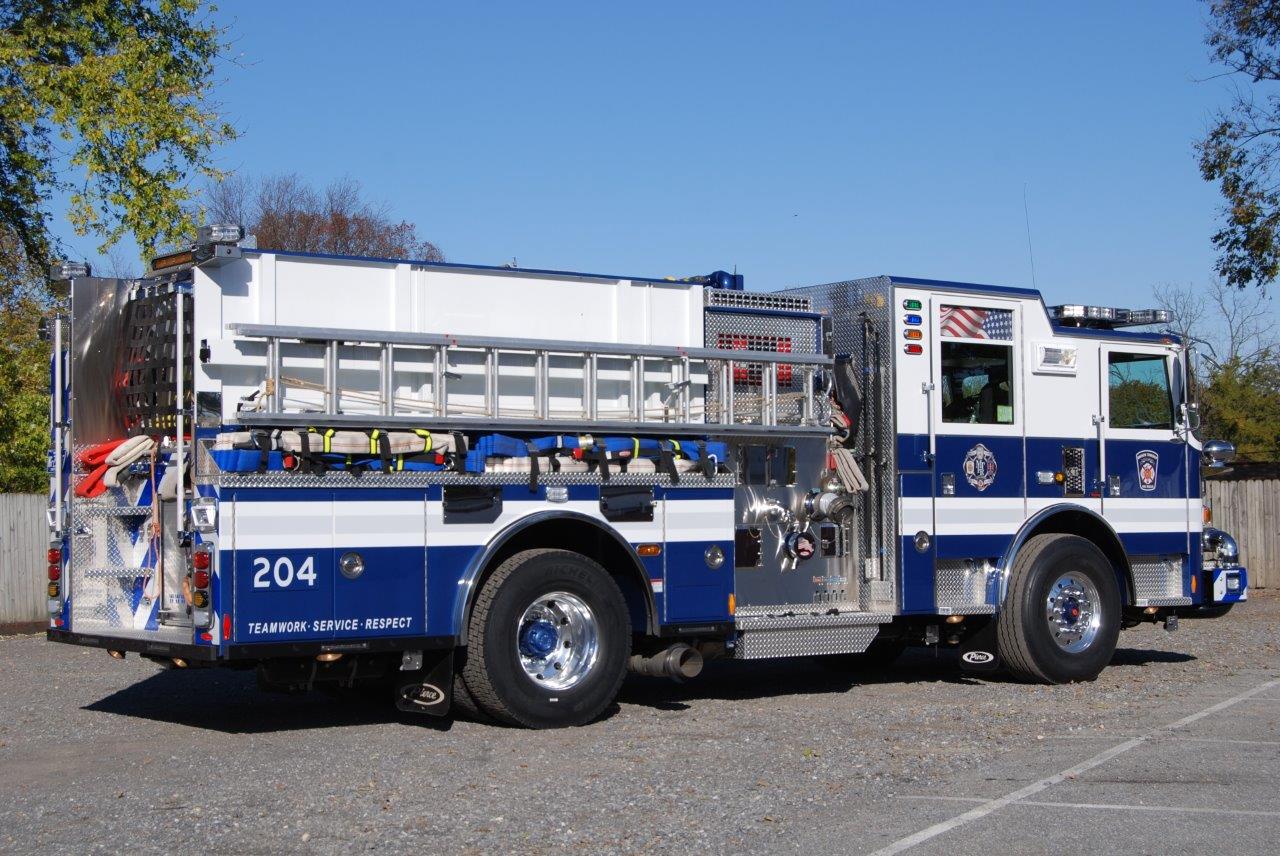
The College Park Fire Department operates as Station 12 in Prince George’s County and protects the University of Maryland campus with numerous high rise buildings. Chief Bill Corrigan oversees the department’s fleet of two engines, foam unit, ladder truck and two ambulances that responded to 4073 incidents during 2011. Engine 122 is a 2012 Pierce Arrow XT 2000 gpm pumper that was designed by the department’s apparatus committee to meet the unique needs of their first due area. The engine is built with a 174.50 inch wheelbase with an L-shaped 500 gallon water tank. The major attack lines come off the rear of the apparatus with a bumper mounted attack line and trash line provided at the left side pump panel. The high rise packs are carried above the right side body compartments which allow personnel to safely deploy them without having to use steps or running boards. Additional safety items include a windshield down view mirror, back up camera and reinforced stainless steel bumper.
For a number of years Rescue Squad 27 from the Morningside Fire Department has been one of the busiest squads in Prince George’s County responding to over 2000 incidents each year. The station in the past had also operated with two engines which account for another 1200 plus runs. With this in mind the members set out to design a rescue engine which could operate as a back up to the rescue squad as well as provide engine company service when required.
Rescue Engine 27 was built by Custom Fire Apparatus on a Spartan Gladiator chassis after many hours of specification development and work by Captain Mike Poetker with the station’s apparatus committee. The rescue engine was built on a 199 inch wheelbase, overall length of 33 feet and 116 inches high. The stainless steel body has full depth compartments on both sides with the ground ladders stored under the hose bed. Using an L-shaped 500 gallon water tank the hose bed is 66 inches from the ground with six preconnected hand lines located in three different locations. The tool and equipment mounting was conducted by Custom Fire to maximize the available space inside of the cab and body.
The Reading, Massachusetts Fire Department set out to replace their aging rear mount ladder truck and after evaluation of their responses acquired a Seagrave Marauder II 100 foot rear mount ladder equipped with a 500 gpm pump and 300 gallon water tank. The department under the command of Chief Greg Burns operates two engines, a ladder truck and medic unit from two stations with on duty personnel. The ladder truck was designed to be able to proved an initial attack line at structure fires if the unit would be the first to arrive as well as for a protection line at vehicle accidents. The Seagrave aerial ladder was built on a 225 inch wheelbase with a stainless steel cab and body. The pre-piped waterway is fed from the rear of the unit with smooth bore tips attached to the ladder pipe. Captain Phil Boisvert and his group worked to develop specifications to replace both engines and the aerial ladder to provide standardized tool, equipment and hose loads on each apparatus.
The history of the Smithfield, Virginia Fire Department can be traced back to 1939 when local residents discussed the need for community fire protection. Today the department is guided by Fire Jason Stallings and operates three engines, tower ladder, rescue squad and brush unit from Station 50 in Isle of Wight County. The department had outgrown their walk in rescue truck on a commercial chassis and sought to replace this with a multi-function apparatus as Smithfield protected a large portion of the county for technical rescue and RIT duties.
Rescue 50 was built by Seagrave with a twenty four foot stainless steel body equipped with a 500 gpm pump, 300 gallon water tank, 30 Kw hydraulic generator, air cascade system and 83 feet of ground ladders. The upper body compartments are accessed by a pull down ladder with full handrails. The steel reinforced front bumper is equipped with a 15,000 pound rated winch, trash line and rope tie offs with a 9000 pound portable winch provided for use at each side and rear of the body.
Combination rescue apparatus can be difficult to design as there are typically many more pieces of equipment that would be nice to have on the apparatus then there is available space to make things easy and safe to access without overloading the unit or making it so large that the squad is difficult to maneuver. The Smithfield Fire Department took many operational aspects into consideration before finalizing the design of their new rescue squad.
In today’s difficult financial climate it is more important than ever to be able to specify apparatus that will meet the needs of the response area while enhancing the safety and operation of the vehicle. Designing apparatus that will serve the department and community into the future with a developed apparatus replacement program will make the procurement process go along smoothly.
Photos included with AA Part 57:
All photos by Tom W. Shand
#1. Allentown Road, Maryland operates this Spartan Crimson pumper with a low hose bed design to permit rapid and safe advancement of attack lines. Note the smooth bore nozzles on both the 2.00 inch and 2.50 inch lines.

#2. Engine 122 of the College Park, Maryland Fire Department was designed to have attack lines and standpipe packs easily accessible from the ground. The short wheelbase pumper can access limited spaces within the response area with the major attack lines coming off the rear.

#3. The Morningside, Maryland Fire Department had Custom Fire Apparatus construct their rescue engine to fit into the limited bay space in their station with a good assortment of rescue and engine company equipment.

#4. Reading, Massachusetts set out to design a new rear mount aerial ladder with a 500 gpm PTO driven fire pump and 300 gallon water tank while maintaining adequate compartment space for all tools and equipment.

#5. Rescue 50 from the Smithfield, Virginia Fire Department carries a full compliment of hydraulic rescue tools, power saws and hand tools together with a 500 gpm pump and 300 gallon water tank. This unit is an excellent example of a combination rescue squad apparatus.

BY Tom W. Shand and Michael Wilbur
Firehouse Magazine November 2012