
We have often commented that backing accidents are almost always preventable and happen with frightening regularity. Not many months go by without reading or hearing about yet another firefighter that was seriously injured or killed when another firefighter backed over them. This month is no different as a 45-year-old FF/EMT is in stable condition with fractures after a fire department member accidentally backed over her with a medium duty rescue truck. A firefighter walking along the side of the road in a spotter position next to the apparatus as it was backing up was stuck and injured. The truck struck the firefighter at a low rate of speed and partially ran over her. Both the apparatus and the injured firefighter were operating at an EMS incident. The injured firefighter was transported to a local hospital before being airlifted to a trauma center were a nurse there confirmed that the firefighter was in stable condition with a fractured tailbone and possibly a fractured pelvis, and that they were running more tests.
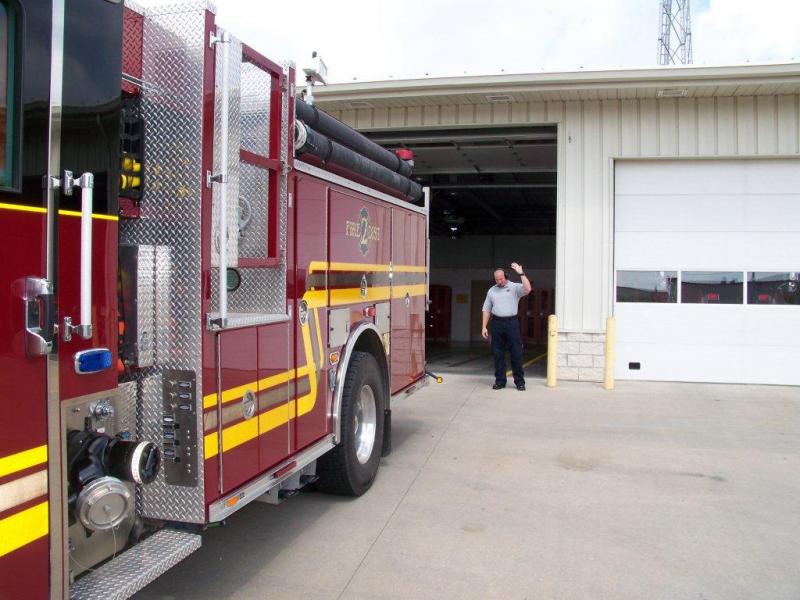
I have been blessed and have been invited to teach and educate in many fire departments in many communities, in many different states across our great country. Within this experience I have been exposed to any number of firefighters, fire apparatus, procedures and technologies. On one recent trip I was exposed to a backup system different from any that I had ever seen used before. We go now to Johnson County, Kansas where I found Consolidated Fire District Truck 21 which was equipped with wired headsets with a receptacle at the rear of the apparatus (Photo 1). This system enables the backer to have visual and voice communication with the apparatus operator (Photo 2). Note that the operator even with voice contact is still intently watching the minors hence watching the spotter which is really important to do. This is especially important with an apparatus such as large a mid-mounted tower ladder and a very tight spot in a condo parking lot (Photo 3). This system certainly makes operating in such tight quarters much safer and far less likely to have an accident. It seems to me as I watched this take place that the headsets really solidify the team concept and really directed the attention of the backer and the operator to the task at hand and prevent distractions.
This was the first time that I had experienced backing the apparatus with the aid of radio headset communications, however one of the class participants said “you haven’t seen nothing yet”. “I will take pictures of a wireless communication system and send them to you,” which he did (Photo 4). I tend to like this system even better as the spotter can be further back away from the apparatus and further to the side of the apparatus making backing over the spotter far less likely. Take note of the position of the head and eyes of the operator of this apparatus equipped with bus mirrors where the operator appears to be looking more ahead rather than to the side as with the other operator with conventional West Coast fire truck mirrors (Photo 5). But with that said the same high level of attention and concentration appears to be just as present here with this operator as it was with the previous operator. I would like to thank Jeff DeBell CFD, Captain Brad Davis and crew, from Johnson County (KS) Fire District 2, Spring Hill station 84 for pictures 4 and 5.
As the warm Fall days will soon turn into cold winter nights November is a transition month in many areas of the country where there will be many days and nights shrouded in fog with very limited visibility or in some cases no visibility at all. Also leaves will be falling from the trees in the rain creating roadways that will be extremely slippery and would rival any ice coated road that will occur later in the winter season. Finally this is also the season where many male animals including the white tail deer in my neck of the woods will be going into rut, aka getting horny, chasing females animals some unfortunately will wind up on roadways perhaps in your path. Please drive with a heighten state of awareness for all of these hazards as November tends to be one of the toughest, most dangerous months to drive.
Finally due to some technical difficulties the article promised on the seatbelt imitative had to be postponed but will appear in this column in early 2011. Thank you for your patience and understanding. Next month we will tackle winter driving tips and strategies.
Firehouse Magazine November 2010
By Michael Wilbur


