
SYNOPSIS
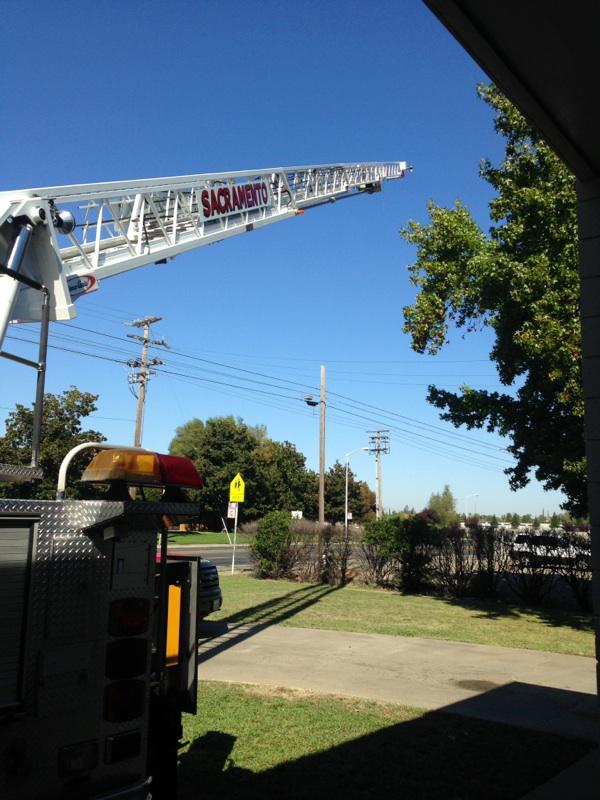
On the morning of Sunday October 5, 2014, the Operator of Tuck 16, standing on the turntable, was preforming his morning readiness check of the aerial and during his check the ladder was rotated to the right, and extended over the power lines that are in adjacent lot north of the fire station. The upper fly/egress section of the ladder was above the power lines, when without warning, the 60Kv line arched to the tip of the truck, creating a loud explosion and knocking the power out to the fire station.
The operator was uninjured but transported to the ER as a precaution for medical check out and evaluation.
NARRATIVE
At approximately 0930 hours, the Operator of Truck 16 pulled the truck on the front ramp to conduct his routine morning checks of the vehicle and part of the check including flying the aerial.
As required by standard procedure, the jack pads, which where the aluminum style, were positioned on the ground and the outriggers were fully extended prior to the operation of the aerial. The aerial was raised out of the cradle, rotated to the right and extended approximately 75-80 feet and at the time of the incident the tip of the aerial was 10 feet above the power lines. When the arc occurred, the operator reported seeing a bright flash and then observed the power line being drawn up or “sucked up” toward the tip of the ladder. He stated at no time did the power line come in physical contact with the aerial.
Instinctively, the operator raised the ladder away from the vicinity of the power lines, and climbed down off turntable.
The Saw Firefighter, who was conducting the morning start-up of the power saws on the ramp adjacent to the truck did not see the event, but heard “explosion” and felt a “whoosh” of air go by him, looked over toward the truck and observed a large brownish smoke cloud on the opposite of the truck. From his vantage point the tip of the aerial was well above the power lines.
Crews inside the station heard the “explosion” immediately followed by complete loss of power to the station.
A physical check of the area and the truck found the left front out rigger appeared to be the point where the arc grounded. There was heat damage to the jack pad and discoloration to the concrete ramp. This appeared to be the only damage to the vehicle.
A secondary area of burn was found at a remote spot from the location of where the outrigger grounded out the arc. This spot was located approximately 30 from the location of the outrigger at the expansion joint in the concrete pad that separates the front ramp from the apparatus room floor. In this expansion joint is a piece of steel that makes up the edge if the apparatus floor pad. This steel was partially burned through with surface burn marks on the concrete.
Sacramento Municipal Utility District (SMUD) repair crew that came to inspect the power lines speculated that the electrical current that passed to the truck to the ground may have also been transmitted through the re-bar in the concrete pad and also grounded out at the steel expansion joint.
SAFETY ISSUES FOR REVIEW
- Never assume that even though the tip is beyond the recommended safety guidelines that the power will not arc to the tip.
- SMUD workers indicated that the use of the metal jack pads most likely prevented further damage to the truck, or more importantly to personnel near or on the truck. Had anyone been in contact or near the truck at the time of the arc that their body (ies) could have acted as the path for the electrical arc to travel and most likely would have ended in serious injuries, if not fatal.
- Don’t become complacent with routine duties, especially involving aerial operations.


