
For over one hundred years fire departments have been operating with motorized ladder company apparatus. Seagrave Fire Apparatus is credited with delivering the first motor driven city service tractor drawn ladder truck to the City of Los Angeles in 1911. Other manufactures including American LaFrance, Mack and Maxim Motors quickly followed suit with their entries into the market. It was not until 1935 when Peter Pirsch and Sons located in Kenosha, Wisconsin delivered the first all metal hydraulically powered 100 foot aerial ladder to the Melrose, Massachusetts Fire Department. During this period most departments were operating with twenty year old spring raised wooden aerials that had been rebuilt from the horse drawn era with motorized tractors.
The development of hydraulically raised metal aerial ladders was at the time one of the most significant innovations to hit the fire service. Many fire departments continued to favor the wooden aerial ladders with both Chicago and New York City ordering these types of tractor drawn ladders through the mid-1950’s. For those departments that did not require an aerial ladder the quad apparatus became an attractive unit to acquire. The city service ladder had somewhat fallen out of favor with the quad equipped a fire pump, booster tank, hose bed and ground ladders. As communities developed after World War II, there was resurgence in purchasing new apparatus where the versatility of quad units gaining favor.
The Ward La France Company of Elmira Heights, New York built a number of massive quad units during this period. These trucks were capable of carrying over 250 feet of ground ladders and were more than forty two feet long. During 1951 New York City placed into service seven Ward La France open cab quads that were equipped with a 750 gpm pump and a 250 gallon booster tank. Two of these units were assigned to Staten Island ladder companies with the others at engine companies that were remote from adjacent ladder companies.
Aerial devices built during the 1950’s were equally split between tractor drawn and straight frame ladders with aerials ranging from 65 feet to 100 feet. With the introduction of the cab forward design by American La France fire departments were now presented with a choice of seating arrangements where two fire fighters could be seated in rear facing jump seats. The cab forward chassis design provided for a shorter overall length vehicle with an improved turning radius over the conventional, engine forward apparatus. Other manufacturers including Mack, Maxim Motors and Seagrave waited to see if the cab forward apparatus would be universally accepted by departments and by 1959 all major apparatus builders had introduced a cab forward design. While aerial ladder technology had not changed much over the preceding twenty years the advances in chassis configuration would greatly impact how aerial ladders would be engineered and built.
Introduced in September, 1958 the Pitman Company delivered the first Snorkel device, a 50 foot articulating platform to the Chicago Fire Department under the direction of Commissioner Robert Quinn. For the next twenty years the Snorkel and its competitors proved their worth at major incidents across the country with its ability to deliver master streams with pin point accuracy and enabling personnel to go up and over obstructions such as power lines, trees and parapet walls. The concept of operating safely inside of a platform would eventually lead to the development of the aerial platform and tower ladder apparatus.
The quad apparatus was replaced by the quint and with the addition of an aerial ladder or elevating platform the quint became the Swiss army knife of fire apparatus. When combined with a cab forward chassis the quint provided a shorter wheelbase and overall length with the ability to fit into a fire station with a ten foot overhead door. American La France somewhat pioneered the quint with their introduction of the 900 series cab forward chassis. These devices had an overall height of just 110 inches with a 100 foot ladder having an overall length of 43 feet, 5 inches and having the capability of carrying 1500 feet of 2.50 inch hose and 208 feet of ground ladders. These vehicles proved to be not only versatile but were compact in size when compared to comparable height platform devices.
Aerial apparatus had traditionally been built with open cabs to provide clear vision for the crew, giving them the ability to position the rig while looking for overhead wires and other obstructions. Open cab vehicles also provided over overall travel heights which were critical when housing aerial apparatus in older stations with limited door clearances. Seagrave Fire Apparatus introduced the Rear Admiral ladder during 1964 with a new rear mounted aerial ladder design. This device provided a shorter overall length vehicle and often replaced older, tractor drawn ladders in some departments including New York, Baltimore and Chicago. The Seagrave rear mount ladder was built with a 226.00 inch wheelbase and overall length of 34 feet, 10 inches the apparatus was considerably shorter than midship or tractor drawn units and could still fit into stations with limited door clearance. Beginning in 1969 New York experimented with rear mount aerials and over the years have enjoyed good success with the rear mount units.
The decade of the 1960’s was one of the most transformational periods in aerial device engineering and design. The success of the Snorkel articulating platforms fostered several other apparatus builders to produce telescopic aerial platforms which would give fire departments even more choices when acquiring new units. Mack and Sutphen followed in later years by Grove and LTI introduced both midship and rear mounted tower apparatus. In addition several European aerial manufacturers partnered with US builders to offer rear mount aerial ladders with working heights of up to 144 feet. While never gaining wide popularity with departments with their inability to carry a sufficient quantity of ground ladders there was now an almost overwhelming number of aerial device choices.
The term “tower ladder” was coined during 1964 when the FDNY placed into service its first 75 foot telescopic platform. Over the years New York placed into service approximately 178 Mack tower ladders on both single and tandem axle chassis. When the definitive history of aerial devices is written the Mack-Baker 75 foot tower ladder will be viewed as one of the most versatile and battle proven apparatus of all time. Many of these venerable rigs are serving with their second and third fire departments with others have been re-mounted on newer model chassis with enhancements to bring them into compliance with current NFPA 1901 standards.
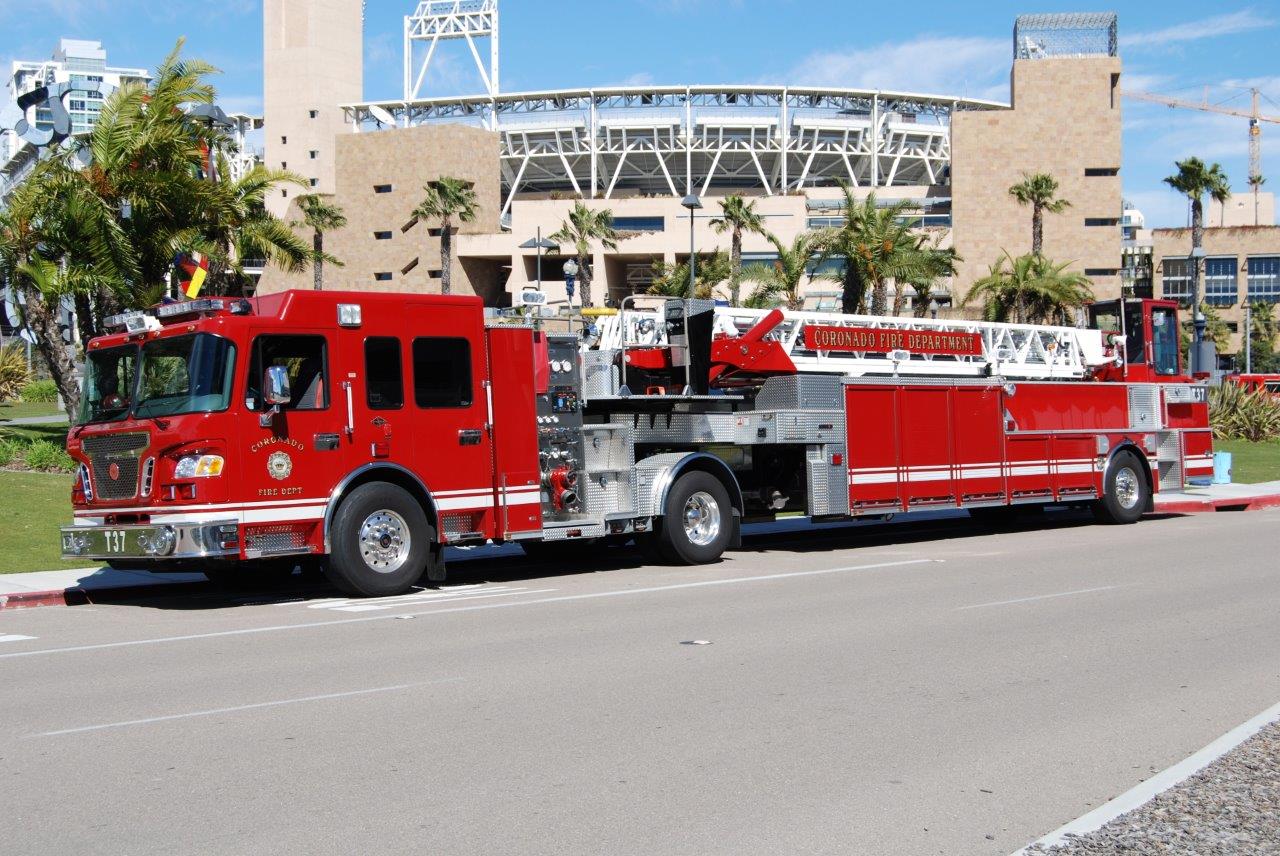
Tractor drawn ladders continue to be the favored style of device with many departments including the Baltimore, Los Angeles City, San Francisco and Seattle. Tiller units while they require a lot of apparatus bay space and enhanced driver operator training provide the greatest amount of space for tools and equipment as well as the ability to carry over 300 feet of ground ladders both inside the trailer and along the sides of the body. Several departments on the west coast have placed into service Quiller units which provide for a fire pump and water tank on the tractor together with preconnected attack lines and supply line hose storage areas.
Aerial devices of any type are the most expensive piece of apparatus that a fire department will acquire. Careful considerations to the type of apparatus that will best meet the needs of the response area and provide sufficient equipment and ground ladder capabilities must be reviewed when developing specifications for new truck company units.
Photos for use in Apparatus Architect-April 2014
Photo #1:

Seven of these Ward LaFrance quads were placed into service by New York City during 1951 to provide ladder company service in outlying areas.
Photo from the Collection of Fire Apparatus Journal
Photo #2:

The Onset, Massachusetts Fire Department operates this 1972 Maxim F model open cab ladder truck equipped with four section 85 foot steel aerial.
Photo by Tom W. Shand
Photo #3:

American LaFrance produced this quint apparatus for the Congers, New York Fire Department in 1971. Note the location of crosslay hose beds just ahead of the hard suction hose.
Photo by Tom W. Shand
Photo #4:

The Gainesboro Fire Department in Frederick County, Virginia operates this 1982 Mack Baker 75 foot tower ladder that formerly saw service with a department in Long Island, New York.
Photo by Tom W. Shand
Photo #5:

Coronado, California Truck 37 is a 2009 Spartan/Crimson 103 foot tractor drawn aerial ladder equipped with a 1500 gpm pump, 300 gallon water tank and 200 feet of ground ladders.
Photo by Tom W. Shand
Firehouse Magazine Apparatus Architect
By Tom W. Shand and Michael Wilbur
April 2014