
Endorsements and Restrictions:
Drivers who operate special types of CMVs also need to pass additional tests to obtain any of the following endorsements on their CDL:
- T – Double/Triple Trailers (Knowledge test only)
- P – Passenger (Knowledge and Skills Tests)
- N – Tank Vehicle (Knowledge Test only)
- H – Hazardous Materials (Knowledge Test only)
- X – Combination of Tank Vehicle and Hazardous Materials
If a driver either fails the air brake component of the general knowledge test or performs the skills test in a vehicle not equipped with air brakes, the driver is issued an air brake restriction, restricting the driver from operating a CMV equipped with air brakes.”
Up to now I do not think that the Commercial Motor Vehicle Safety Act has asked anyone to do anything that would seem to be unreasonable. In fact ridding the road of bad drivers is a cause that we all could and should get behind and support.
Waiver Provisions:
“All active duty military drivers were waived from the CDL requirements by the Federal Highway Administrator. A State, at its discretion, may waive firefighters, emergency response vehicle drivers, farmers and drivers removing snow and ice in small communities from the CDL requirements, subject to certain conditions. “
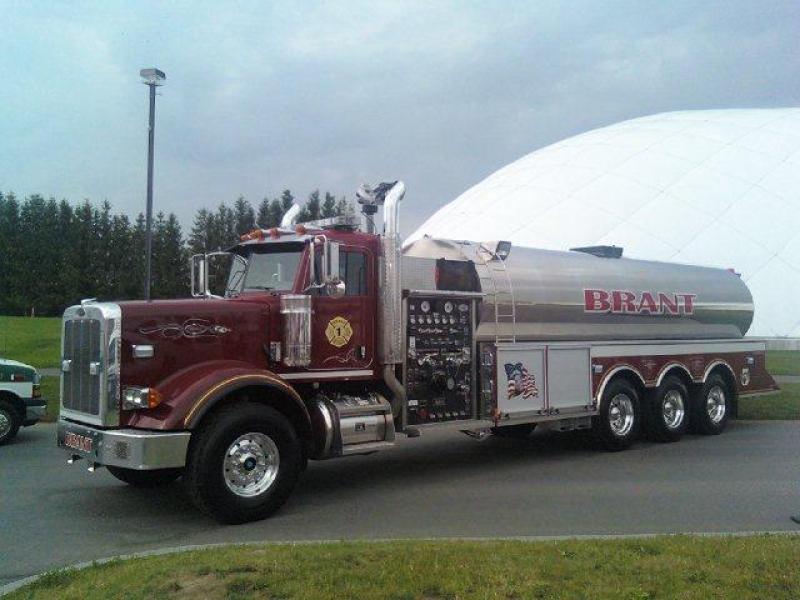
The creators of this piece of legislation choose to offer waivers to some groups. The first was the military although we do not advocate exemptions from the very safety rules meant to keep the roads safer for everyone, if you understand the amount of training that goes into a military commercial vehicle operator this provision is completely understandable. We have friends in the military and their driver certification for large vehicles is a model for the rest of us. The next group who could be waived and exempted are firefighters. There are two states that choose not to waive firefighters California and Connecticut. In the case of California they have a graduated CDL system where a fire apparatus operator must take a written and a road test to be qualified to drive fire apparatus in that state. Once the tests are passed and all of the requirements have been met the state DMV takes the firefighters car license and endorses that license to drive fire apparatus. If that firefighter wanted to get a CDL in California he or she would have to fulfill all of the requirements that normal commercial vehicle operators have to as part of the CDL process in that state. Connecticut has a similar format where a firefighters license is endorse with a ‘Q” hence the Connecticut fire apparatus license is called the “Q”. These are the only two states that I am aware of that have taken the act of driving fire apparatus seriously and responsibly. If you have a special licensing requirement for fire apparatus in your state please lets us. But most of you will not. Why? Because most of the states have exempted the fire service from the very safety rules put in place to make the roads safer for everyone. One might ask how can this be firefighters are in the business of public safety surely they would not petition there state legislators to except themselves from the very safety rules put in place for everyone. Yes that is exactly what has happened; most fire departments have an exemption from the Federal Motor Vehicle Safety Act of 1986. What other safety rules are we exempted from that other commercial vehicle operators must abide by: Firefighters are exempt from wearing seatbelts. Fire Apparatus Operators do not have to submit to random alcohol and drug testing like their CDL counter parts. Fire Apparatus Operators do not have to submit to a D.O.T. annual physical examination like their CDL counter parts and finally according to a 1991 NTSB Special investigation of Eight Fire Truck Accidents only 19 states require fire apparatus to be inspected periodically by the State or by designated fleet inspection stations. One of the accidents investigated occurred in the state of Connecticut prior to that accident the State did not require the inspection of emergency vehicles. After the accident, the Connecticut Department of Motor Vehicles initiated a voluntary non-fee inspection program for fire service vehicles. From July 1, 1990 to January 3, 1991, the CDMV inspected 559 fire apparatus from 64 cities and towns. During this period, 193 or 35 percent, of the fire apparatus failed the CDMV roadside inspection. That’s right over a full one third of the apparatus inspected failed. Fifty percent of the deficiencies involved brakes, 18 percent involved steering systems, and the remaining deficiencies involved tires, suspension systems, and fuel leaks. Fire apparatus are machines things break, things wear out, things go wrong how can we exempt ourselves from that? This is a symptom of a much more serious problem.
But just like CDL’s , a Graduated CDL or verifiable third party training might not be the total answer to apparatus training, apparatus inspections given recent history may not be the end or and cure all to that problem either. In the City of Boston a Lieutenant was killed in January when the brakes failed on the apparatus and in March of 2008 a Louisiana apparatus operator was killed driving a tanker that was not fully NFPA compliant and had a partially bald tire on the front axle. What makes this accident particularly troubling is that the apparatus had been inspected the month before and had accumulated less than 200 miles since that inspection. The bottom line here is that apparatus inspections are only as good as the mechanics that conduct them and the inspector is only going to check those components on the vehicle that are required by the licensing state.
The medical exemption is also troubling as numerous apparatus operators have suffered heart attacks or stress induced line of duty deaths responding to and returning from alarms.
Exempting apparatus operators from random alcohol and drug testing is completely irresponsible. One would only have to look at our country to realize that our civilian population has a drug and alcohol abuse problem. Well where you think fire apparatus operators come from the moon. The fire service has had their head in the sand on this issue for way to long. Truck drivers working for trucking companies, pilots, ships captains, doctors, nurses and yes even the DPW employee driving the garbage truck in your town must submit to random alcohol and drug testing. We are in the business of providing safety we should represent the safest group on the road, but unfortunately instead of raising the safety bar we slither under it. Yes some firefighters including myself are required to submit to testing as a condition of our employment however this is the exception and not the rule.
“In addition, a State may also waive the CDL knowledge and skills testing requirements for seasonal drivers in farm-related service industries and may waive certain knowledge and skills testing requirements for drivers in remote areas of Alaska. The drivers are issued restricted CDLs. A State can also waive the CDL hazardous materials endorsement test requirements for part-time drivers working for the pyrotechnics industry, subject to certain conditions. “
OTHER REQUIREMENTS
There are a variety of other requirements related to this legislation which affect the commercial drivers, their employing motor carriers and the States.
Penalties:
The Federal penalty to a driver who violates the CDL requirements is a civil penalty of up to $2,500 or, in aggravated cases, criminal penalties of up to $5,000 in fines and/or up to 90 days in prison. An employer is also subject to a penalty of up to $10,000, if he or she knowingly uses a driver to operate a CMV without a valid CDL.
CDLIS Clearinghouse:
States must be connected to the Commercial Driver’s License Information System (CDLIS) and the National Driver Register (NDR) in order to exchange information about CMV drivers, traffic convictions, and disqualifications. A State must use both the CDLIS and NDR to check a driver’s record, and the CDLIS to make certain that the applicant does not already have a CDL.
BAC Standards:
The FHWA has also established 0.04% as the blood alcohol concentration (BAC) level at or above which a CMV driver is deemed to be driving under the influence of alcohol and subject to the disqualification sanctions in the Act. States maintain a BAC level between .08% and .10% for non-CMV drivers.
Employer Notifications:
Within 30 days of a conviction for any traffic violation, except parking, a driver must notify his/her employer, regardless of the nature of the violation or the type of vehicle which was driven at the time.
If a driver’s license is suspended, revoked, canceled, or if he/she is disqualified from driving, his/her employer must be notified. The notification must be made by the end of the next business day following receipt of the notice of the suspension, revocation, cancellation, lost privilege or disqualification.
Employers may not knowingly use a driver who has more than one license or whose license is suspended, revoked or canceled, or is disqualified from driving. Violation of this requirement may result in civil or criminal penalties.
Disqualifications:
- For a conviction ( listed under other requirements) while driving a CMV , drivers must be disqualified and lose their privilege to drive for 60 to 120 days:
- Two or more serious traffic violations within a 3-year period. These include excessive speeding, reckless driving, improper or erratic lane changes, following the vehicle ahead too closely, and traffic offenses in connection with fatal traffic accidents 90 days to 5 years.
- One or more violations of an out-of-service order within a 10-year period.1 Year
- Driving under the influence of a controlled substance or alcohol; or
- Leaving the scene of an accident; or Using a CMV to commit a felony.3 Years:
- Any of the 1-year offenses while operating a CMV that is placarded for hazardous materials. Life
- Second offense of any of the 1-year or 3-year offenses; or using a CMV to commit a felony involving manufacturing, distributing, or dispensing controlled substances.
- States have the option to reduce certain lifetime disqualifications to a minimum disqualification period of 10 years if the driver completes a driver rehabilitation program approved by the State.
- If a CDL holder is disqualified from operating a CMV, the State may issue him/her a license to operate non-CMVs. Drivers who are disqualified from operating a CMV cannot be issued a “conditional” or “hardship” CDL or any other type of limited driving privileges to continue driving a CMV.
- For disqualification purposes, convictions for out-of-state violations will be treated the same as convictions for violations that are committed in the home State. The CDLIS will ensure that convictions a driver receives outside his or her home State are transmitted to the home State so that the disqualifications can be applied.
CURRENT STATUS OF THE CDL PROGRAM
Over 8 million drivers have passed the knowledge and skills tests and obtained a CDL. Approximately 11 percent of these CDL drivers have been disqualified at least once during the period of April 1992 through June 1996.
Building on the success of the CDL program, the FMCSA is exploring ways to enhance and improve the effectiveness of the CDL program. Some of the current enhancements and future enhancements being considered include:
Current:
- Driver Data Exchange With Canada and Mexico.
- CDL Judicial Outreach Project (JOP).
Future:
- Graduated Commercial Licenses.
- Third Party CDL Knowledge Testing.
- Merging Medical Fitness Determination into CDL Process.
- Simulator Validation for Training & Testing
The fire service could use one or more of the Future initiatives to be enacted now.
One of the reasons cited for the fire service to seek and except these exemptions are the associated costs. This old argument rings hollow. It is the same argument used to fight OSHA back in the 1980’s in a time period where we were experiencing between 130 and 170 line of duty deaths annually. “It will put the fire service out of business” “Volunteer Firehouses will have to close.” “We will go broke.” Were just some of the fear tactics used to fight the implementation of the OSHA standards. The only factual thing that occurred is that some states like my home state of New York became an OSHA state and the fire service line of duty death rate dropped by over one third. I personally believe if it were not for OSHA some firefighters might still be wearing orange fireball gloves and a rubber rain coat to do interior structural firefighting in this country.
Where do we stand in my state New York? We just received our second CDL exemption from the state legislature in the last twenty years. You see several years ago the state legislature change part of the Vehicle and Traffic Law in the state to secure federal funding which inadvertently created a situation where fire apparatus were being driven out of class. Certainly something had to be done but another exemption was not the answer. However that is exactly what was done. What was the final impetus to get the state legislature to grant the exemption in such a timely fashion? There might not be any fire trucks in the Memorial Day parades in New York State in 2009. But I am certain that fire trucks in a Memorial Day parade were not on the mind of Jane Barker as she is busy raising five fatherless children. You see her husband Ryan was killed in a fire apparatus crash in New York State last year. Ryan was not wearing a seatbelt and was ejected and killed so certainly some personal responsibility was lacking. However as you read the NIOSH investigative report on this accident the fact that there is a seatbelt exemption in the law which the report suggested should be overturned represents one of many causative factors. Other causative factors listed included original tire and brakes on the 1978 apparatus, the lack of training or any training records, the fact that firefighters had complained about the ill handling apparatus including Firefighter Barker at the scene of the incident just prior to returning to quarters when the accident happened and finally a new booster tank that appeared not to be installed as per the tank manufacturer’s specifications. No one can say for sure if this line of duty death could have been prevented by eliminating the safety exemptions, but one thing for certain it surely would have helped. By embracing these exemptions as status quo we should all be ashamed.
What can we do? I believe that there is a silent majority in the fire service that exists that wants to be responsible and do the right thing as it relates to this important safety issue. If you have some positive input or constructive criticism we would like to hear from you however in some cases firefighters write in to criticize the concept or the author but do not provide a life saving alternative In the next column we will outline a plan of action. If you or your departments have any ideas for this plan you can reach me at Firehouse Magazine, Firehouse.com or at www.emergencyvehicleresponse.com
As always the comments represented here are those of the author and the author only.
Hope to see many of you at the end of the month at the great Firehouse Expo in Baltimore until then keep safe and give this column some serious consideration.
Firehouse Magazine September 2009
By Michael Wilbur
